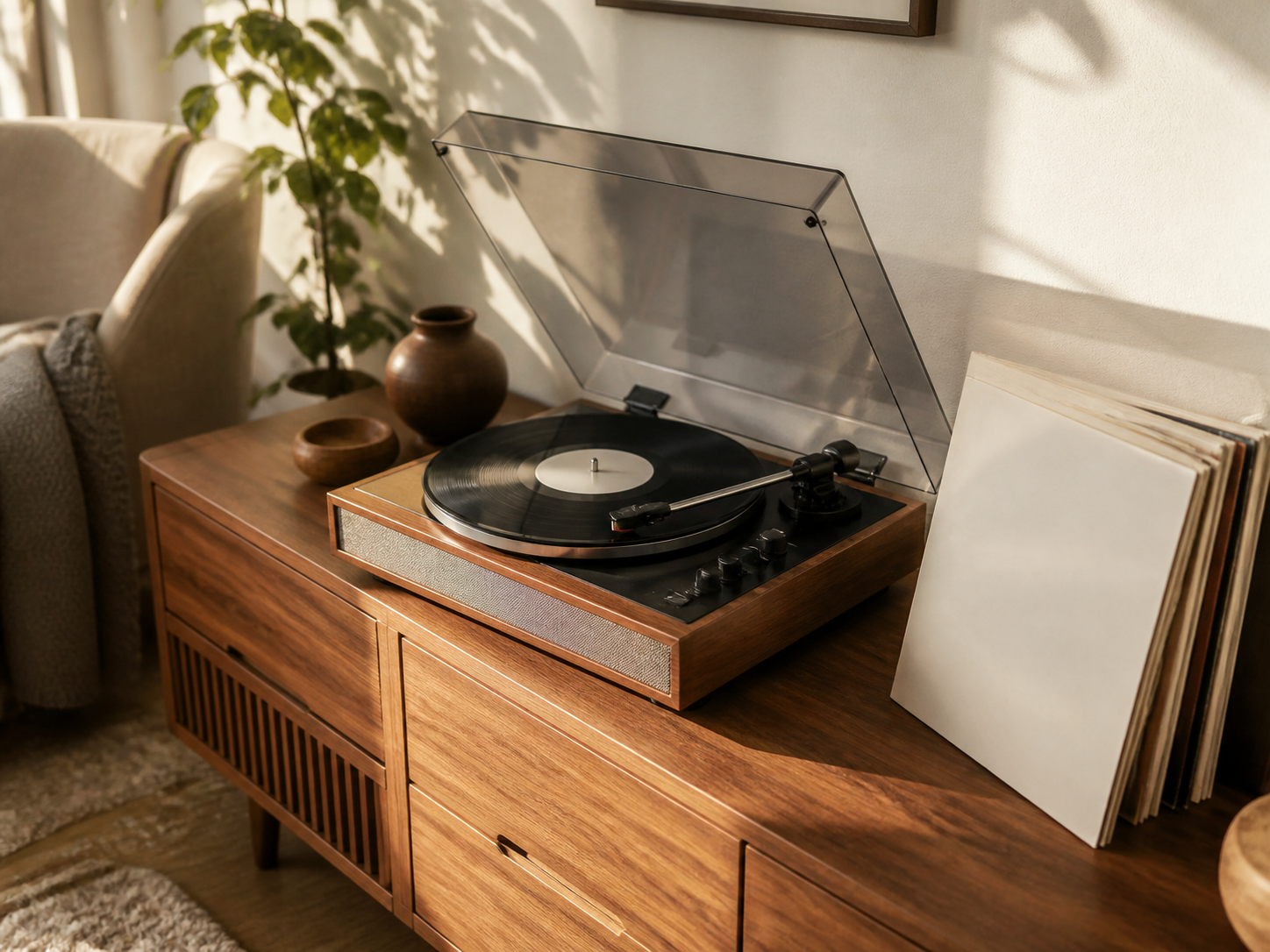
AI-generated illustrations; products may vary. Browse products via the shop links.
Record Player: For someone ready to put a record on
A record player gives a vinyl collection a place in their everyday listening. Choose a complete setup that fits their home, whether they want simple controls or a more involved turntable.
Ad: GiftAim earns commission or fees from qualifying purchases and sign-ups through links on this page, at no extra cost to you. How we’re funded.
A player on its own may not be the whole gift
Check where the sound will come from before comparing finishes. An all-in-one player includes speakers, while a separate turntable may need them. If the recipient already has a system, find out which inputs it offers. If they are starting from scratch, include the rest of the equipment in your budget.
The cartridge's signal needs a phono preamp, sometimes called a phono stage. This may be built into the player, provided by a suitable amplifier's phono input, or bought separately. A player's line output can feed a compatible line input on powered speakers or an amplifier. Powered speakers include amplification; passive speakers require an amplifier. Check the manufacturer's connection diagram so each part of the proposed system has a job.
The direction of Bluetooth matters. Bluetooth input can let a phone play music through the unit without sending the record anywhere wirelessly. For listening to vinyl on compatible wireless headphones or speakers, look specifically for Bluetooth output. A listing that merely says 'Bluetooth' leaves an important question unanswered.
Match the controls to the listener
A fully automatic player can lower and return the tonearm for them. A manual turntable leaves those actions to the listener, which may be part of the appeal. Auto-stop usually describes stopping playback rather than a complete automatic arm-return system; read the model's description.
Look for clear assembly instructions and find out whether the tonearm needs tracking-force adjustment—the setting that determines the stylus's pressure in the groove. Check that a replacement stylus, the needle that reads the record, is available for the exact cartridge. Styling and the number of advertised functions don't tell you how well a player will sound.
Check their records against the supported speeds. Many modern records play at 33⅓ or 45 rpm, short for revolutions per minute. A collection of older 78s calls for further checks, including the appropriate stylus, rather than simply selecting any three-speed player.
Picture it in their room
Allow enough shelf depth and clearance for the lid, cables and controls. A firm, level surface and sensible separation from vibration help the player do its job. Separate speakers also need suitable positions, so include their space requirements when judging a compact-looking setup.
If their current turntable is doing everything they need, consider a vinyl record storage rack for the growing collection instead. For a first player, a favourite album and all the necessary connections are more useful than an upgrade that leaves no money for speakers.
Already happy with their player? A wanted vinyl record album gives them music without replacing the setup. Check the wanted recording and edition against their existing collection.