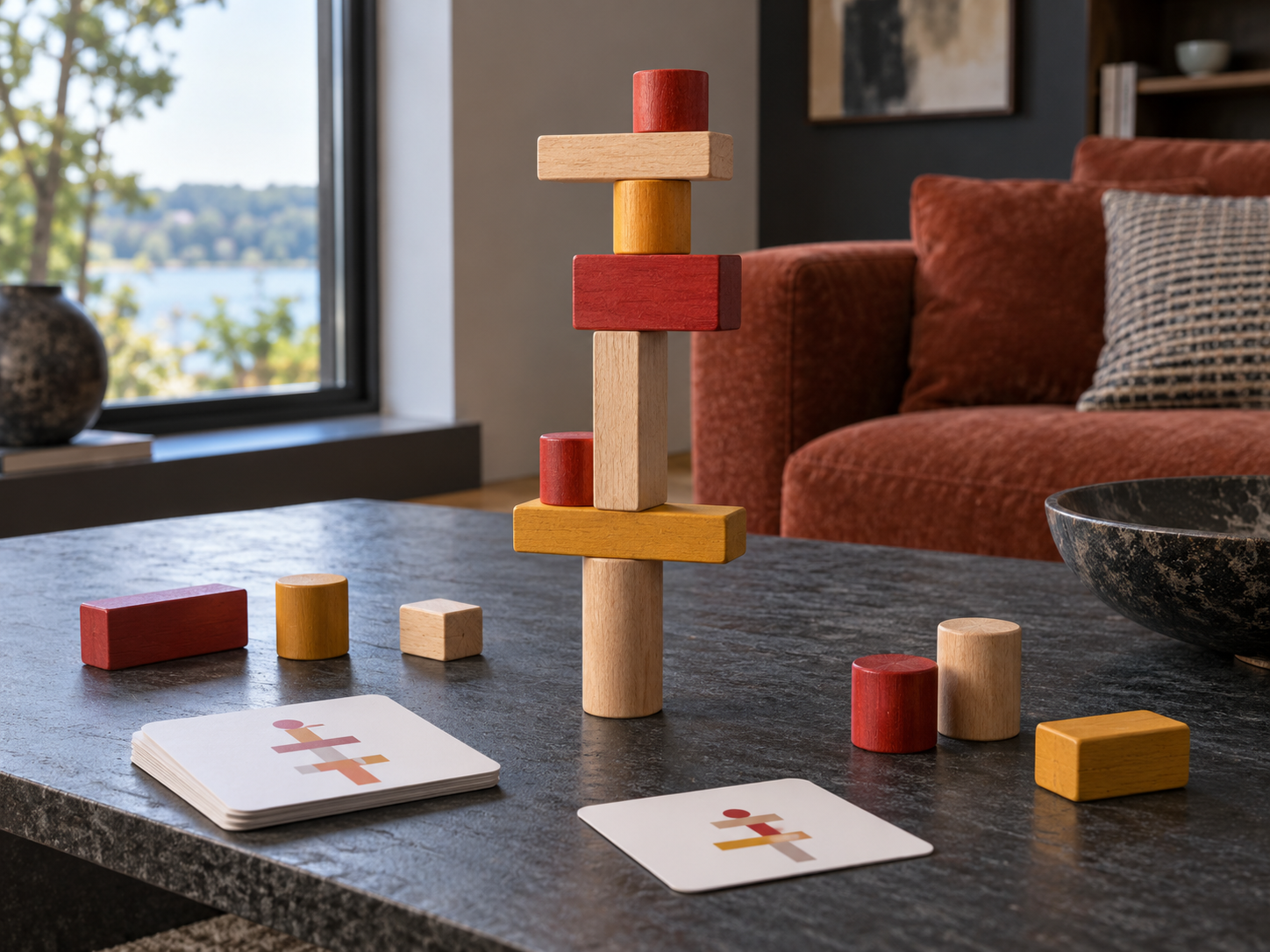
AI-generated illustrations; products may vary. Browse products via the shop links.
Dexterity Board Game: How steady is their game-night hand?
Stacking, balancing or flicking gives a dexterity game its challenge. Pick one around the movements they enjoy and the people who will share the table.
Ad: GiftAim earns commission or fees from qualifying purchases and sign-ups through links on this page, at no extra cost to you. How we’re funded.
Start with what the players do
A dexterity game asks players to do something physical within a set of rules: balance an awkward piece, flick towards a target or remove an object without bringing the rest down. It's a lively alternative when the group would enjoy a practical challenge more than a long explanation.
Watch for a standalone game rather than loose construction pieces. The rules, player range and supplied components should explain the activity. Expansions and extra-piece packs can be useful for an existing favourite, but they don't necessarily provide a game on their own.
A simple rule can still ask a lot
Consider the movement involved. Delicate grips, rapid reactions and reaching across a board are different demands, even when the box describes the game as easy to learn. Some players would welcome a quiet turn-based challenge and dislike being timed.
The exact edition's player count matters, as does the table. A tiny travel tin can contain surprisingly small pieces; a large flicking board may need more room than they can leave clear. Check dimensions and handling rather than judging scale from the photograph.
Look at the size and contrast of pieces and targets.
Find out whether players take turns or act at once.
Read what happens after a mistake: another attempt, a penalty or sitting out.
Use the manufacturer's age guidance, particularly around small parts and younger children in the household. A game being amusing for adults says nothing about whether those parts are suitable for a toddler.
Make room for another go
Resetting and packing away should fit the way they'll use it. A quick round is less useful at a party if rebuilding the game takes most of the evening. Storage that keeps the pieces together can matter more than an elaborate presentation box.
A strategy board game may suit someone who prefers a considered plan. For a group that enjoys words and social prompts, consider a party card game instead.